
The Warning Nobody Heard
On an April afternoon in 2019, deep inside Rack 15 of the McMicken battery facility outside Phoenix, Arizona, a single lithium-ion cell was dying. Tiny dendrites (crystalline needles that had been growing silently for weeks) bridged the gap between anode and cathode, creating an internal short circuit. Within minutes, the cell temperature rocketed from 30°C to over 700°C. The electrolyte vaporized. Toxic and flammable gases poured into the sealed enclosure.
Here is the part of the story that should keep every developer awake at night: the cell did not explode immediately. It vented. It off-gassed. For roughly an hour, flammable vapors accumulated inside the container while firefighters staged outside, waiting for the smoke to subside. When they opened the door, fresh oxygen mixed with those accumulated gases. The container exploded in seconds. Four firefighters were hospitalized.
The McMicken investigation, led by DNV and Arizona Public Service, took over 18 months to complete. Among its many findings was an uncomfortable truth that would reshape how the industry thinks about fire detection: the traditional detection methods (smoke detectors, heat sensors, voltage monitoring) only see the fire after it has started. They are reactive. They tell you that something terrible is already happening.
But thermal runaway does not begin with fire. It begins with gas. Before a lithium-ion cell reaches thermal runaway, it vents trace amounts of electrolyte vapors and Volatile Organic Compounds (VOCs). This off-gassing can begin up to 30 minutes before temperatures reach the point of no return. That is not a footnote in a research paper. That is a 30-minute intervention window, long enough to electrically isolate the affected cells, cut charging current, activate ventilation, and potentially prevent the event entirely. The question facing every developer in 2026 is no longer whether off-gas detection works. It is whether you can afford to build a project without it.
The Science: What the Battery Tells You Before It Burns
To understand why off-gas detection matters, you need to understand the anatomy of a thermal runaway event. It is not a switch that flips. It is a sequence with distinct, measurable stages.
Stage 1: Cell Degradation. Something goes wrong inside the cell. An internal short circuit. Overcharging. A manufacturing defect. The cell begins to heat beyond its normal operating window. At this point, the Battery Management System (BMS) may or may not detect the anomaly. Voltage monitoring can miss internal shorts that do not immediately affect terminal voltage. Temperature sensors on the outside of the module may lag behind the internal cell temperature by critical minutes.
Stage 2: Electrolyte Venting. As the cell temperature rises past roughly 80–120°C (depending on chemistry), the organic electrolyte solvent begins to decompose and vaporize. The cell’s pressure relief vent opens, releasing these vapors into the enclosure. This is the off-gas. The composition is a cocktail of volatile organic compounds: dimethyl carbonate, ethyl methyl carbonate, ethylene, and other electrolyte solvents that are chemically distinct from the gases that combustion produces later. This is the critical distinction: off-gas is a precursor signal, not a byproduct of fire. It appears before thermal runaway, not during it.
Stage 3: Thermal Runaway. If nothing intervenes, the exothermic reactions inside the cell become self-sustaining. Temperature exceeds 200°C and accelerates. The cell releases hydrogen, carbon monoxide, hydrogen fluoride, and other flammable and toxic gases at high volumes. At this stage, the fire is underway. Smoke detectors and heat sensors now activate, but the window for prevention has closed. You are in containment mode.
Stage 4: Propagation and Accumulation. The heat from the runaway cell raises the temperature of adjacent cells, modules, and racks. Flammable gases accumulate inside the enclosure. If concentrations exceed the Lower Flammable Limit (LFL) and an ignition source is present, deflagration or explosion follows.
The entire industry’s fire safety framework (NFPA 855, NFPA 68/69, UL 9540A, deflagration panels) is designed around Stages 3 and 4. It assumes thermal runaway will happen and focuses on preventing propagation and explosion. Those are essential protections. But they are fundamentally reactive.
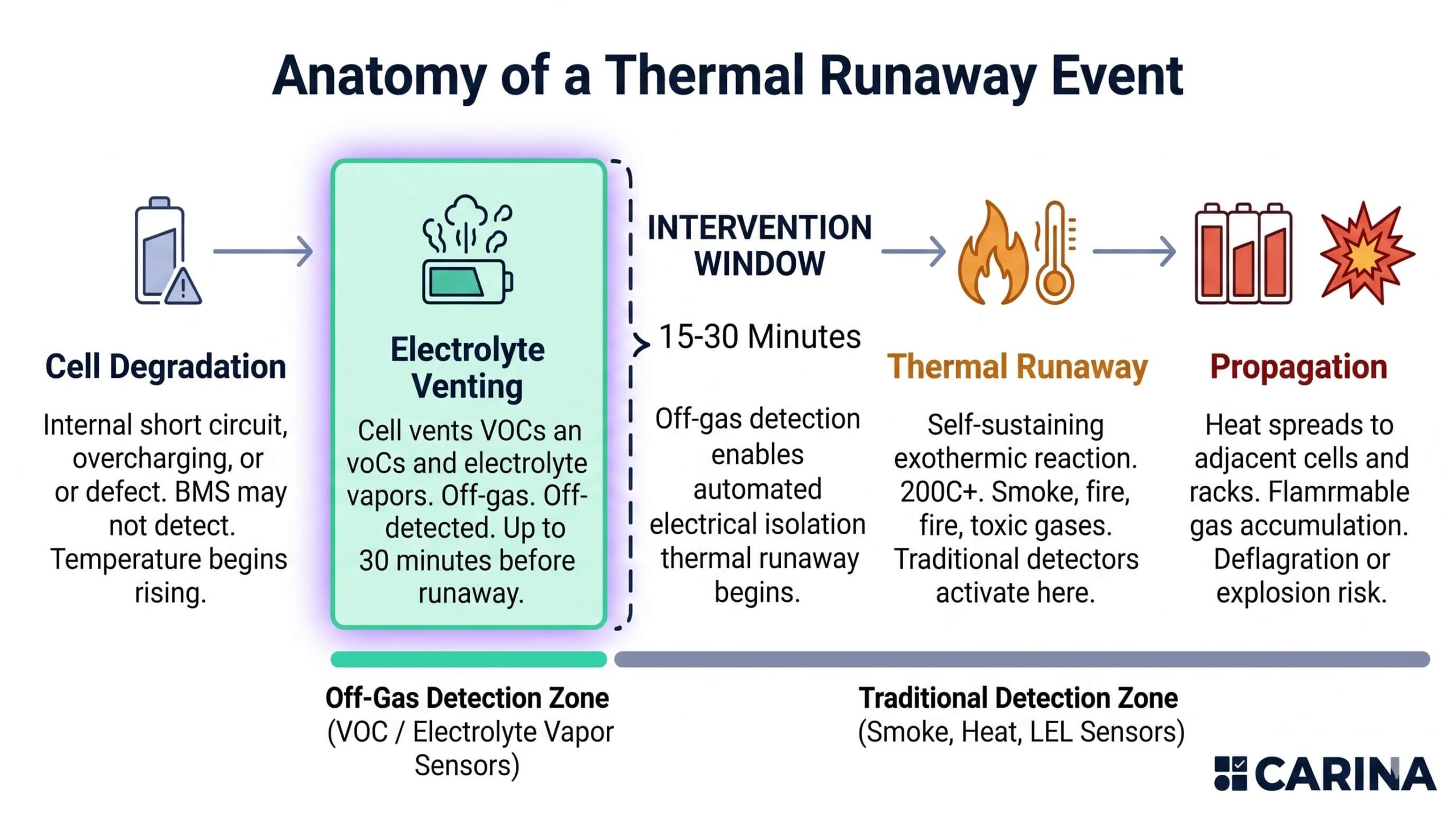
Off-gas detection inserts a layer of protection between Stage 1 and Stage 3. It detects the electrolyte vapors during Stage 2, before the cell reaches the point of no return, and triggers automated electrical isolation to cut the energy supply feeding the reaction. It does not replace fire suppression, explosion control, or emergency response. It precedes them. Think of it this way: smoke detectors tell you the house is on fire. Off-gas sensors tell you the wiring is overheating.
THE CARINA RULE
“The cheapest fire to fight is the one that never starts. Off-gas detection is not a fire safety upgrade. It is an early-intervention system that creates an electrical isolation window before thermal runaway begins.”
- The Goal: Shift from reactive containment to active prevention.
- The Mechanism: VOC/electrolyte vapor sensors (cell- or rack-level) interlocked with BMS-triggered electrical isolation.
- The Standard of Care: NFPA 855 (2026), FM Global DS 5-33, FM 6540 / UL 2075 sensor certification.
- The Task: FPE-100 (Fire Safety Design Basis)
The Regulatory Convergence: Four Standards, One Direction
What makes 2026 a turning point is not any single code change. It is the convergence of four independent regulatory and market forces, all pointing in the same direction:
NFPA 855 (2026 Edition). The cornerstone standard for stationary energy storage installations now requires a Hazard Mitigation Analysis (HMA) for essentially all installations, removing previous capacity-based exemptions. More significantly, Annex G explicitly acknowledges the limitations of traditional LEL sensors and voltage monitoring as thermal runaway safeguards and highlights off-gas monitoring as one of the most effective methods for early detection. The standard notes that cell-level detection close to or inside battery modules provides the most reliable pre-thermal-runaway warning. The 2026 edition also introduces Thermal Runaway Propagation Prevention (TRPP) systems: active, automatic systems that detect precursors to thermal runaway (including off-gas) and actuate targeted suppression to stop propagation before it begins.
FM Global Data Sheet 5-33. FM Global’s property loss prevention guidance for lithium-ion BESS now recommends an “early-intervention system” that automatically and electrically isolates the batteries using off-gas detection capable of detecting volatile organic compounds (electrolyte solvent vapors) preceding thermal runaway. This is not a suggestion buried in an appendix. It is a specific, actionable recommendation from the world’s largest industrial property insurer, and FM Global-insured facilities are increasingly expected to comply with it.
FM 6540 and UL 2075. These are the certification standards for the detection sensors themselves. FM Approvals Standard 6540 tests rate-of-rise gas detection specifically designed for lithium-ion off-gases. UL 2075, recently revised, covers detector design, construction, and performance. Together, they create a third-party validation pathway that answers the question insurers and AHJs have been asking: “How do we know this sensor actually works?” When a fire marshal or underwriter asks whether your off-gas system is “certified,” these are the standards they are referencing.
NFPA 400 (2025 Edition). Often overlooked in BESS-specific conversations, NFPA 400 requires exhaust ventilation systems to account for the density of potential vapors from hazardous materials. Off-gas detection supports compliance by automatically triggering ventilation when electrolyte vapors are detected, creating an interlock between detection and NFPA 69’s requirement to keep enclosure concentrations below 25% of the LFL.
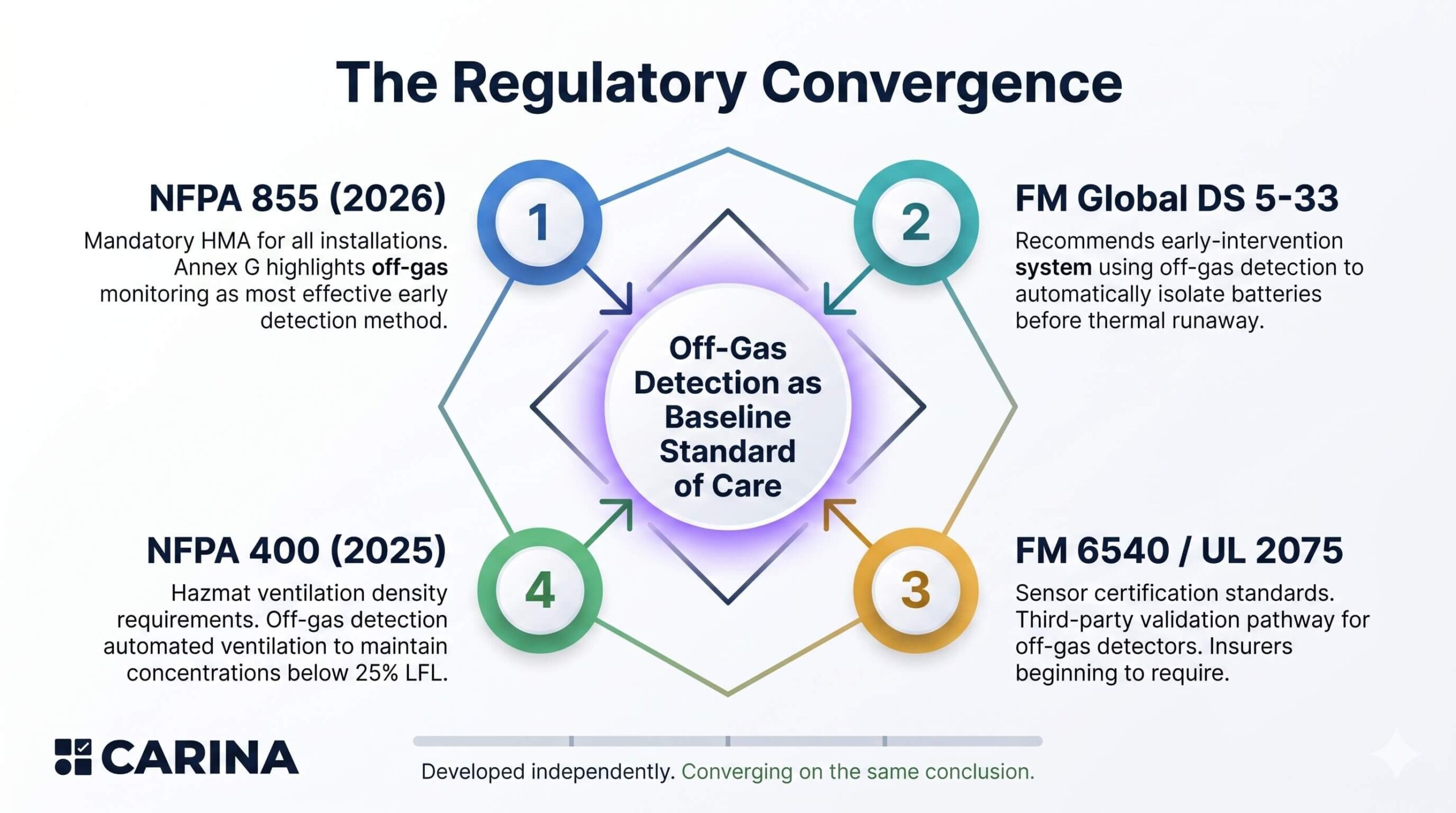
These four standards were developed independently by different organizations with different mandates. They were not coordinated. The fact that they are all converging on the same conclusion (that early detection of electrolyte vapors is a superior intervention strategy) is not a coincidence. It is the regulatory system digesting the lessons of McMicken, Moss Landing, Liverpool, and every other BESS incident where traditional detection was activated too late.
The Insurance Squeeze
If the codes do not convince you, the insurance market will. Fire risk remains the dominant underwriting concern for BESS. Insurers are now requiring detailed documentation of thermal management protocols and emergency response procedures as baseline conditions of coverage. But the market is moving further: off-gas detection certification status is increasingly becoming a factor in coverage terms and premium pricing.
The logic is straightforward from the insurer’s perspective. A BESS with FM 6540-certified off-gas detection and automated electrical isolation has a fundamentally different risk profile than one relying solely on smoke detectors and deflagration panels. The former can potentially prevent a thermal runaway event from propagating at all. The latter can only manage the consequences after it has started. That difference is quantifiable in actuarial terms, and it is beginning to show up in policy language. For developers, this creates a new variable in the financial model. The cost of off-gas detection hardware is a line item in CapEx. The cost of not having it is a question mark in your insurance premium, your coverage scope, and your lender’s comfort level with the project’s risk profile for the next 20 years.
The Early Adopters Are Already Here
If this sounds like a future problem, it is not. Connecticut and Austin, Texas have already embedded off-gas detection requirements into their local codes for BESS installations. They are the first, not the last. As NFPA 855 (2026) adoption spreads across state and local jurisdictions (and it will, because NFPA 855 is the only chapter-level standard specifically addressing stationary energy storage), more AHJs will reference or adopt these requirements. Some will do so explicitly through local BESS-specific ordinances. Others will do so implicitly through the fire marshal’s interpretation during the permitting process. The pattern should look familiar to anyone who has tracked BESS moratoriums. A fire marshal reads the latest NFPA guidance. A neighboring jurisdiction adopts a BESS ordinance with off-gas requirements. The planning board starts asking questions at the CUP hearing.
By the time you are standing in front of the board, the standard has already shifted beneath you, and your project was designed to the old one.
The OEM Question: Not All Products Are Equal
Here is where the rubber meets the road for developers: not all OEM products currently include off-gas detection, and not all detection systems are created equal. Some Tier 1 OEMs are integrating cell-level or rack-level VOC sensors directly into their battery enclosures as standard equipment. Others offer it as an optional add-on. Others do not offer it at all and would require third-party systems engineering to retrofit detection onto their product. The distinctions that matter are:
Sensor placement. Cell-level or rack-level sensors placed inside the battery modules detect electrolyte vapors closest to the source, providing the earliest possible warning. Enclosure-level sensors detect accumulated gases, which is better than nothing but a slower signal with a narrower intervention window.
Detection type. VOC and electrolyte vapor detection is distinct from traditional combustible gas detection (H₂/CO sensors). Combustible gas detectors are designed to sense the products of active thermal runaway. VOC sensors detect the precursor vapors that appear before runaway begins. They are measuring different things at different points in the event timeline.
Certification. An FM 6540-approved or UL 2075-listed sensor has been independently validated against a published test method for lithium-ion off-gas detection. An uncertified sensor may work perfectly well, but when your fire marshal or insurer asks for documentation, “it works, trust us” is not an answer that closes permits or binds coverage.
Automated isolation logic. Detection without isolation is an alarm, not an intervention. The critical question is what happens after the sensor triggers: does the system automatically open contactors to electrically isolate the affected cells or racks? How fast? Seconds or minutes? Is the trip logic managed by the OEM’s BMS, or does it require third-party integration with the site SCADA? The speed and reliability of the detection-to-isolation sequence determine whether you are preventing a thermal runaway event or merely documenting one.
Data accessibility. Who owns the detection system data? Can the owner and O&M contractor access alarm timestamps, sensor readings, and isolation actions, or is that data locked behind the OEM’s proprietary platform? This matters for insurance claims documentation, incident investigation, and (increasingly) for FEOC effective control analysis if the OEM retains exclusive access to safety-critical operational data.
These are questions that need to be asked during procurement, not discovered during commissioning.
The “We’ll Add It Later” Mistake: A Hypothetical Scenario
Consider a developer who secures a 20-acre site in a growing jurisdiction. The fire code at the time of permitting references NFPA 855 (2020), which does not explicitly require off-gas detection. The developer proceeds with an OEM product that includes standard smoke detection and deflagration panels but no VOC sensing.
The project is permitted, built, and energized. Eighteen months later, the jurisdiction adopts the 2026 edition of NFPA 855 and the fire marshal issues updated guidance referencing FM DS 5-33. The project’s insurance carrier, at renewal, requests documentation of early-intervention detection per the FM recommendation. The carrier does not refuse coverage, but the renewal premium increases, and the policy now excludes certain thermal runaway scenarios from full indemnification.
The developer investigates retrofitting off-gas detection. The OEM’s enclosure was not designed for rack-level sensor integration: there are no sensor ports, no pre-wired signal paths, and the BMS firmware does not support third-party detection inputs. A retrofit would require opening every container, installing aftermarket sensors, engineering a parallel SCADA integration, and re-commissioning the fire detection system. The estimated cost: six figures, plus downtime.
The alternative: accept the higher premium and the coverage gap for the remaining 18 years of the project’s operating life. Neither option existed in the original pro forma.
What Developers Should Be Asking Right Now
This is not a call to mandate off-gas detection on every project in every jurisdiction. There are sites where it is not required by code, not demanded by insurers, and not economically justified today. But the direction of travel is unmistakable, and developers who ignore it are making a bet, not a decision. The questions worth asking at the feasibility stage are:
Does my jurisdiction require it? Check whether the AHJ has adopted NFPA 855 (2026), references FM DS 5-33, or has enacted a local BESS-specific ordinance with off-gas detection or early-intervention requirements. Connecticut and Austin are known adopters. Your jurisdiction may already be there, or the fire marshal may be reading the same guidance you have not looked at yet.
Does my insurer expect it? Ask your insurance broker whether off-gas detection certification status (FM 6540 / UL 2075) affects coverage terms, exclusions, or premium pricing. Ask the question now, before you select an OEM, not at policy renewal.
Does my OEM offer it? If you are evaluating OEMs, ask each one whether their product includes integrated off-gas detection. Ask about sensor type, placement, certification, automated isolation logic, and data accessibility. If the OEM does not offer it, ask what third-party integration would require and what it would cost.
What is my cost of inaction? If the regulatory and insurance trend continues (and there is no indication it will reverse) what is the cost of building without off-gas detection today and needing to retrofit or absorb higher insurance costs later? Is the incremental CapEx of including it now less than the NPV of the risk you are carrying without it?
These are not rhetorical questions. They are feasibility inputs that belong in your project economics alongside interconnection costs, permitting timelines, and equipment pricing.
Conclusion: The Standard Is Moving. The Question Is Whether You Are Moving With It.
The BESS industry has spent the last five years building its fire safety framework around containment: deflagration panels, fire-rated spacing, suppression systems, emergency response plans. That framework is essential. It is not going away. But it is being augmented by a new layer that sits upstream of containment, a layer focused on prevention through early detection.
Off-gas detection is not a silver bullet. It does not eliminate fire risk. It does not replace NFPA 69 explosion prevention, UL 9540A testing, or your Hazard Mitigation Analysis. What it does is create an intervention window, measured in minutes rather than seconds, where automated electrical isolation can potentially stop a thermal runaway event before it begins.
The regulatory convergence of NFPA 855 (2026), FM DS 5-33, FM 6540, and the insurance market is making this intervention window part of the baseline standard of care. Not every jurisdiction requires it today. But the direction is clear, and the gap between “recommended” and “required” is closing faster than most project timelines.
The developers who will navigate this transition most efficiently are the ones asking the right questions now (at feasibility, during OEM evaluation, and before they commit capital) rather than discovering the answers during permitting, insurance renewal, or commissioning. In the era of early detection, the most valuable 30 minutes in your project may be the ones you never have to use.
Carina Energy provides BESS Development-as-a-Service for developers and infrastructure funds, including fire safety and code compliance screening, OEM technical evaluation, and full-spectrum Owner’s Representative services from fatal flaw to COD. If you are evaluating a site and want to know whether off-gas detection should be on your radar before you commit capital, contact us to discuss your project, or request a Site Reality Check (Fatal Flaw Analysis) on your next site.
More from The Carina Rules
The Fire Code Trap: Why Your BESS Permit Just Got Rejected Off-gas detection sits upstream of fire code compliance — it prevents the event that fire codes are designed to contain. This article covers the downstream side: how NFPA 855 setbacks, UL9540A spacing, and local fire code amendments determine whether your BESS physically fits the site, and why the Fire Marshal’s interpretation governs your layout more than the OEM’s spec sheet.
NVIDIA’s BESS Guidelines for AI Factories NVIDIA’s 33-page self-qualification framework requires OEMs to disclose UL 9540A status and fire protection approach — but explicitly excludes safety testing from its scope. This article translates the 12-test framework for developers and identifies the critical site-level work (including fire protection review) that falls outside the qualification boundary.
Why BESS Development Isn’t “Solar Plus Batteries” Off-gas detection is one piece of a fire safety discipline that most solar teams have never encountered. This article explains the full scope: why BESS development requires a Fire Protection Engineer, a BESS Owner’s Engineer, and 504 coordinated tasks that don’t exist in solar development — and what happens when teams try to run a solar playbook on a storage project.