
Last Updated: June 2026.
Battery energy storage is not solar with batteries bolted on. The permitting variables are fundamentally different, the regulatory landscape is less mature, and the consequences of getting the sequence wrong are more severe.
Solar permitting is largely a function of acreage, viewshed, and agricultural land conversion. Wind permitting turns on setbacks from dwellings, sound studies, and avian impact. BESS permitting, by contrast, is driven by fire safety. The OEM you select determines the fire code envelope. The fire code envelope determines the site plan. The site plan determines the permit application. Get the sequence backwards and you will redesign the project mid-permitting, miss AHJ deadlines, and potentially lose your interconnection queue position.
This distinction matters because most BESS projects are entering jurisdictions where the zoning ordinance was never written with battery storage in mind. Unlike solar, which has been the subject of statewide model ordinances for over a decade, BESS is still an unlisted use in the majority of U.S. counties. That means the entitlement path almost always requires a discretionary approval (a Conditional Use Permit, Special Use Permit, or Special Exception before a Zoning Hearing Board), with public hearings, broad AHJ latitude to impose conditions, and real denial risk.
The organizing principle of this guide is what we call Permit Before You Design: the discipline of sequencing development decisions so that permitting inputs are confirmed before engineering outputs are locked. Technology selection, fire code analysis, civil design, and permit submission are not parallel workstreams. They are sequential dependencies. Treating them otherwise is the single most common (and most expensive) mistake in BESS development.
The Carina Rule
OEM selection drives fire code. Fire code drives site plan. Site plan drives permits. Reverse any link in that chain and you create a redesign cascade that costs months and hundreds of thousands of dollars.
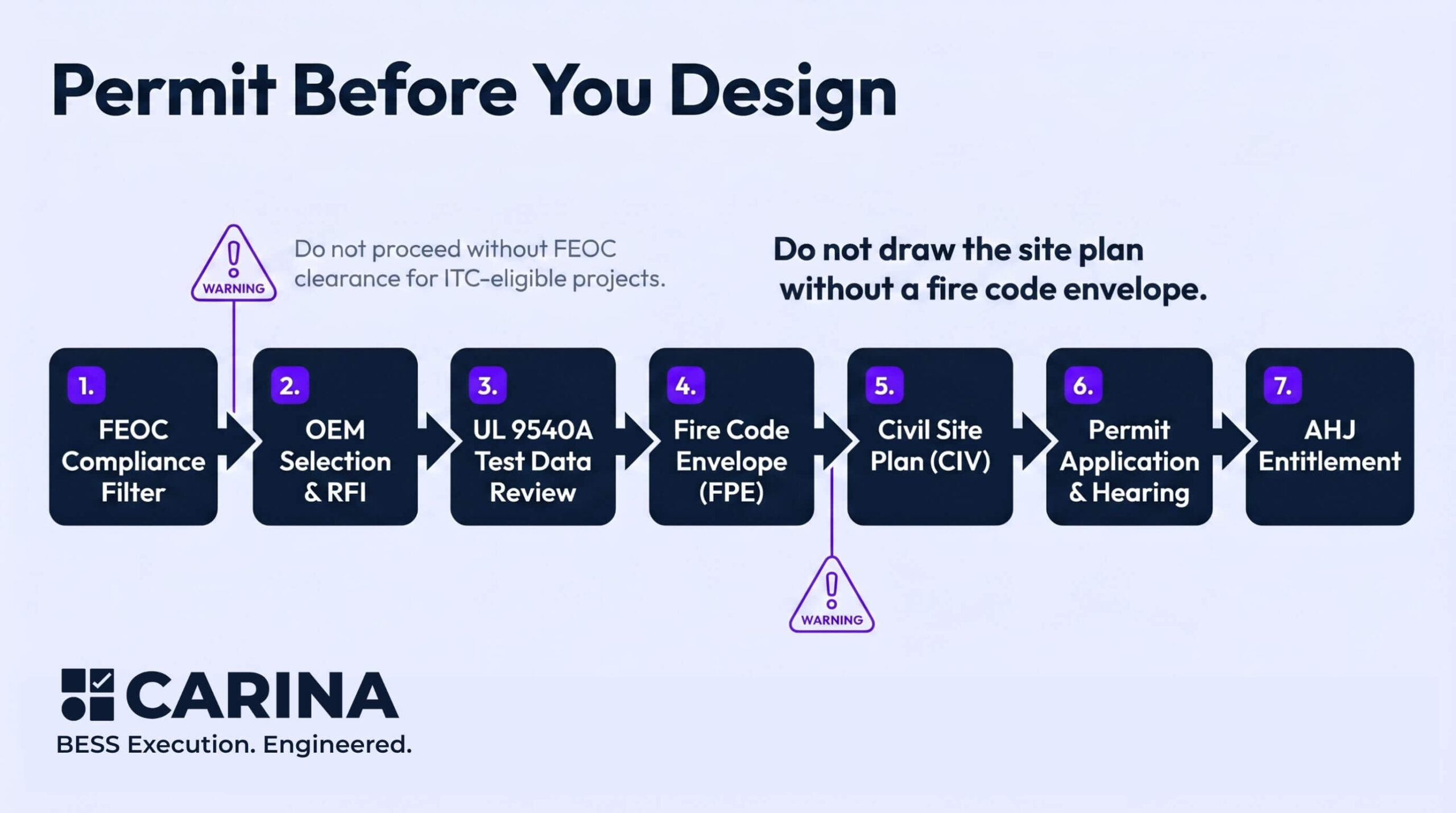
BESS permitting involves multiple layers of government authority, each with distinct jurisdiction, review standards, and timelines. Understanding the architecture before you engage any single agency prevents surprises and sequence errors
Most standalone BESS projects on private land do not trigger federal permitting. The key question is whether there is a federal nexus: federal land (BLM, USFS), federal funding, or a federal permit requirement such as a U.S. Army Corps of Engineers Section 404 permit for wetland fill. If none of those apply, NEPA (the National Environmental Policy Act) is not triggered.
However, even when NEPA is not required, environmental due diligence still matters. Lenders and tax equity investors expect a Phase I Environmental Site Assessment, a wetlands delineation (or a confirmation that jurisdictional wetlands are absent), a threatened and endangered species screening, and a cultural resources desktop review. These are project finance deliverables, not just regulatory obligations.
When NEPA is triggered, the process typically begins with an Environmental Assessment (EA), which evaluates potential impacts and either results in a Finding of No Significant Impact (FONSI) or requires escalation to a full Environmental Impact Statement (EIS). For BESS projects on BLM land, the Bureau has used Determinations of NEPA Adequacy (DNAs) where the BESS falls within the scope of a broader solar or wind project that was already analyzed. For standalone BESS on private land, federal environmental review is the exception, not the rule.
Beyond NEPA, several other federal requirements may apply to BESS projects even on private land without a federal nexus:
Bald and Golden Eagle Protection Act (BGPA). If eagles or eagle nests are present on or near the project site, an eagle take permit from USFWS may be required. This applies regardless of whether NEPA is triggered. Desktop screening through the USFWS IPaC tool can flag eagle habitat early, but confirmation typically requires a field survey.
Migratory Bird Treaty Act (MBTA). While BESS projects pose lower avian risk than wind facilities, land clearing during nesting season can trigger MBTA compliance. Timing construction activities outside nesting windows is the standard mitigation.
Spill Prevention, Control, and Countermeasure (SPCC) Plans. Under the Clean Water Act, an SPCC plan is required for facilities that store oil above certain aggregate thresholds (1,320 gallons aboveground or 42,000 gallons underground). On BESS projects, the oil-filled main power transformer and any diesel generators for construction or backup power can trigger this threshold. SPCC plans must be prepared before operations commence and are a project finance data room deliverable.
Clean Water Act Section 402 / NPDES. Construction activities disturbing more than one acre require an NPDES permit for stormwater discharge, administered by the state under EPA delegation. While this is operationally a state permit, it originates in federal law and is often overlooked in early-stage screening.
State-level permitting involves two distinct categories that developers must track independently: permits and reviews that apply to every BESS project regardless of the local siting path, and state siting preemption frameworks that offer an alternative to local zoning for large projects.
State Permits That Apply Regardless of Siting Path
Even when a BESS project is permitted locally through CUP/SUP, several state-level permits and reviews may be required:
State endangered species. Most states maintain their own lists of threatened and endangered species, separate from the federal ESA. State T&E surveys and permits are administered by the state Department of Natural Resources (DNR) or equivalent wildlife agency. A species may be state-listed but not federally listed, meaning a project that clears the federal ESA screen can still be stopped by a state T&E finding.
State wetlands and waterways. Many states regulate wetlands and waterways beyond the scope of federal Section 404 jurisdiction. State DNR or environmental agency permits may be required for any activity within or adjacent to state-regulated wetlands, streams, or floodplains. In states with strong wetland protection programs (Michigan, Minnesota, Wisconsin, New York, New Jersey, among others), the state wetland permit can be more restrictive and slower than the federal Section 404 process.
State environmental review acts. Several states have their own environmental review requirements that function independently of federal NEPA. Washington’s SEPA, California’s CEQA, New York’s SEQRA, and similar laws require environmental review of projects that need discretionary state or local approvals. For BESS, these reviews are typically triggered by the CUP/SUP application and are administered by the local lead agency, but they are state-mandated processes with state-defined standards.
State cultural resources. State Historic Preservation Office (SHPO) consultation may be required by state law even without a federal nexus, depending on the jurisdiction. Some states require cultural resources review for any project that receives state funding, state permits, or involves ground disturbance above certain thresholds.
State building and fire codes. States adopt building codes (typically IBC) and fire codes (typically IFC or NFPA) at the state level, which local jurisdictions then enforce. The specific code edition adopted by the state determines which version of NFPA 855 applies, which in turn drives the fire protection requirements for the project. Some states (Connecticut, Massachusetts) enforce building codes at the state level rather than delegating to local jurisdictions.
State DOT / oversize-overweight transportation permits. Delivery of BESS containers, transformers, switchgear, and other large equipment to the project site requires oversize/overweight load permits from the state Department of Transportation (and sometimes county road commissions). Route surveys must confirm bridge load ratings, overhead clearances, and turning radii along the delivery path. These permits are typically obtained by the EPC contractor or hauler, but route feasibility should be confirmed during the fatal flaw screening (this is part of the Site Access evaluation).
State stormwater programs. NPDES construction stormwater permits are administered by state environmental agencies under EPA delegation. The permit application (Notice of Intent) and the Stormwater Pollution Prevention Plan (SWPPP) are state-level deliverables even though the authority originates in federal law.
State Siting Preemption for Large Projects
An accelerating trend in U.S. energy regulation is the creation of state siting boards with authority to approve large energy projects, preempting local zoning. For BESS developers, this is both an opportunity and a strategic decision.
Several states have enacted siting frameworks that apply to BESS above certain capacity thresholds:
The developer’s strategic calculus depends on the local jurisdiction’s posture. If the local AHJ is hostile, has an active moratorium, or lacks the technical capacity to evaluate a BESS application, the state path may be faster and more predictable. If the local AHJ is cooperative and the zoning ordinance is workable, local permitting often preserves more flexibility, avoids the state agency’s queue, and in some states qualifies the community for financial incentives (Michigan’s Renewables Ready Communities Award, for example, applies only to locally permitted projects).
The Carina Rule
Evaluate both the state and local permitting path before filing anything. The right path depends on the specific jurisdiction, not on a blanket preference. A hostile township with a pending moratorium and a state siting board that has processed five BESS applications in the last year is a different decision than a cooperative county with a planning director who has already approved three solar projects.
Local permitting is where most BESS projects are won or lost. The AHJ (Authority Having Jurisdiction) is the entity with enforcement authority: typically the county or municipal planning department for zoning, the building department for building permits, and the fire marshal or fire district for fire code compliance.
The critical distinction at the local level is between discretionary permits and ministerial permits.
Discretionary permits require a judgment call by the AHJ. A Conditional Use Permit (CUP), Special Use Permit (SUP), or Special Exception involves public notice, a public hearing, review by a planning commission or zoning hearing board, and a vote. The AHJ can approve, approve with conditions, or deny. This is the critical path for nearly every utility-scale BESS project, because battery storage is rarely an enumerated use in zoning ordinances. Even where it is addressed, most ordinances classify off-site BESS as a special or conditional use in the zones where it is typically sited (agricultural, industrial, sometimes commercial).
Ministerial permits, by contrast, are administrative. Building permits, grading permits, electrical permits, and driveway/access permits are issued by staff when the application meets the code requirements. These follow the discretionary approval, not the other way around.
The practical implication: the discretionary permit is the project’s permitting critical path. Everything downstream (engineering, procurement, construction) is gated by it. And the discretionary process is driven by politics, community sentiment, AHJ expertise with BESS, and the quality of the applicant’s safety narrative, not just technical compliance.
A permitting strategy built from a database printout or a desktop screening tool will miss the most important variables: whether the planning director has ever seen a BESS application, whether the fire marshal understands NFPA 855, whether there is organized opposition, whether there is a moratorium under consideration, and whether previously permitted projects in the jurisdiction set a precedent that helps or hurts your application. These questions are answered by calling the AHJ directly, not by querying a database.
Separate from the zoning and building permit process, fire authorities have independent jurisdiction over BESS safety. The fire marshal (state, county, or municipal) reviews fire protection plans, approves the Hazard Mitigation Analysis (HMA), signs off on the Emergency Response Plan (ERP), and may impose conditions on spacing, water supply, and access that override or supplement the zoning approval.
This means a BESS project can obtain zoning approval and still be stopped by the fire authority. It also means the fire code deliverables (HMA, ERP, Commissioning Plan, Emergency Operations Plan) are not post-construction paperwork. They are, increasingly, required as conditions of zoning approval or as prerequisites for building permit issuance. Jurisdictions that have adopted NFPA 855 require these documents before the project can operate. Jurisdictions that have adopted state-level siting laws (like Michigan PA 233) require them as part of the application.
The practical lesson: engage the fire authority early, ideally during the fatal flaw screening phase. If the fire marshal has concerns that cannot be addressed within the site constraints, you want to know that before you invest in the CUP application.
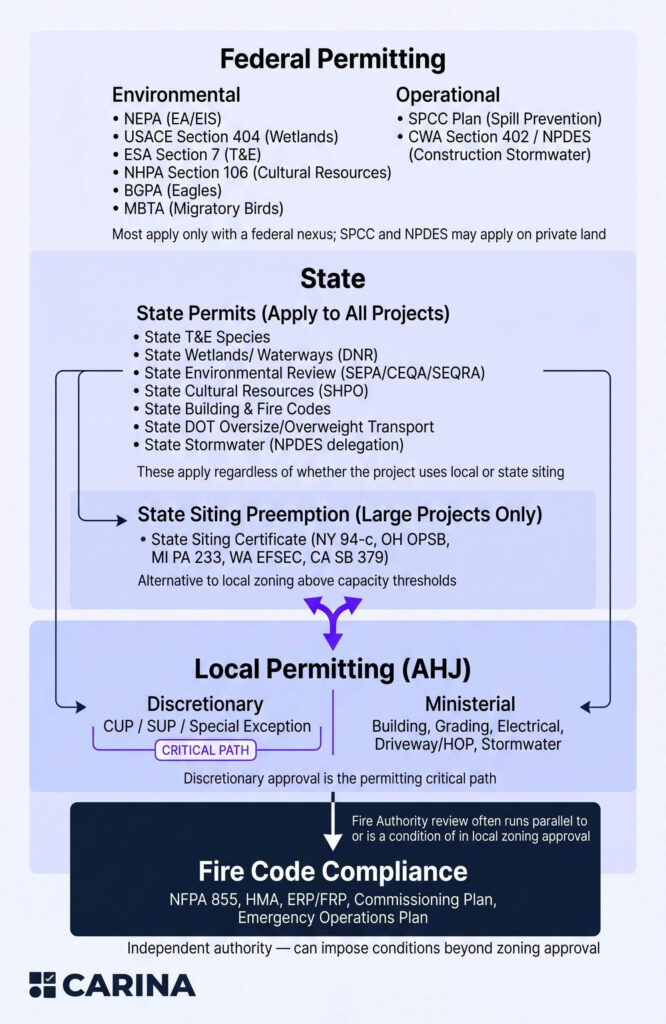
This section walks through the correct development sequence. Each phase is presented in dependency order: the output of each phase is a required input to the next. Skipping a phase, or running phases in parallel without the prerequisite inputs, creates redesign risk.
Before signing a land option, the threshold question is: can this site be permitted at all? Not “can this site be engineered” or “can this site be interconnected,” but specifically: does the jurisdiction allow this use, can the parcel physically accommodate the target capacity, and are there fatal flaws that no amount of engineering can cure?
A rigorous fatal flaw screening evaluates the site across multiple risk dimensions: land dimensions and form factor (is the parcel large enough and the right shape?), permitting and site control (what approvals are required and is there precedent?), fire safety (is there adequate water supply and fire department response capability?), environmental constraints (wetlands, threatened species, cultural resources, floodplain), site access (can delivery trucks reach the site?), site conditions (topography, geotechnical, seismic), interconnection proximity (how far is the nearest substation and is there available capacity?), utilities (power, water, telecom for construction and operations), and miscellaneous research items (existing structures, deed restrictions, easements, mineral rights).
The buildable area question is answered by a parametric site area model that builds up from the project’s target capacity (MW and MWh at the point of interconnection) through the equipment footprint, supporting infrastructure (substation pad, laydown area, stormwater, O&M building, fire water storage, perimeter road, vegetative screening, fence corridor), zoning setback expansion, and a safety/contingency margin. The output is the total estimated parcel area required.
Two critical caveats at this stage:
First, the fire setback used in the site area model is a placeholder. The actual fire setback is determined by the selected OEM’s UL 9540A test data, which has not been produced yet because OEM selection has not occurred. This is precisely why the fatal flaw screening is a feasibility screen, not a final design. It tells you whether the site is in the right ballpark, not whether the site plan will work after OEM selection and fire code analysis.
Second, the site area calculation must account for capacity augmentation. Lithium-ion batteries degrade over time, and the augmentation schedule (when and how much additional battery capacity is added to maintain contractual performance) is driven by the project’s offtake structure. A 20-year tolling agreement with a capacity (MWh) performance guarantee requires a different augmentation schedule than a merchant project with no contractual performance floor. That difference translates directly into physical space: a project with an aggressive augmentation schedule may need 20% or more additional site area reserved for future battery blocks compared to a project that overbuilds capacity at initial installation and accepts degradation. The site area model must carry this reserve from day one, because the augmentation space drives the parcel size requirement, and the parcel size must be confirmed before the option is signed.
Typical cost for a rigorous fatal flaw screening on a single site: under $5,000, with the technical site screening led by a civil engineer and the permitting analysis conducted through direct AHJ outreach.
The Carina Rule
Never sign a land option without a fatal flaw screening. The $5,000 spent on screening a site that turns out to be unpermittable is the cheapest money in development. The $250,000 spent engineering a site that should never have been optioned is the most expensive.
Once a site passes the fatal flaw screening, the permitting strategy is built through direct engagement with the Authorities Having Jurisdiction. This is not a database query. It is a series of phone calls and, where possible, in-person visits to the county planning department, the zoning office, the building department, the fire marshal, and (if relevant) the state DOT.
The output is a permitting matrix: a jurisdiction-by-jurisdiction inventory of every required approval, organized by review type, with timeline estimates, dependency notes, and risk flags. This matrix is the permitting critical path. It feeds the project schedule, the budget, and the development strategy.
Why does this outreach approach matter? Because third-party desktop screening tools (the kind that query zoning databases and generate automated reports) cannot answer the most important permitting questions. They can tell you the parcel is zoned Agricultural. They cannot tell you that the planning director approved a solar project on the adjacent parcel last year and is favorable to energy development. They cannot tell you that a township supervisor is drafting a BESS moratorium resolution for next month’s board meeting. They cannot tell you that the fire marshal has never reviewed an NFPA 855 submittal and will need education before the application is filed. Those facts drive the permitting outcome. They are discovered through direct outreach, not through a database.
This is where most development teams get the sequence wrong. The natural instinct is to run OEM evaluation, fire protection engineering, civil design, and permitting as parallel workstreams to compress the schedule. The problem is that each of those workstreams produces outputs that are inputs to the next one.
The correct sequence:
The consequence of reversing steps 2 and 4 is a redesign cascade. If the civil engineer draws a site plan based on generic assumptions, and the fire protection engineer subsequently determines that the selected OEM requires wider spacing or a larger water supply, the site plan must be redrawn, the permit application must be revised, and any AHJ submissions (including public hearing exhibits) must be updated. If the project is in the interconnection queue, a site plan change that alters the electrical configuration may trigger a material modification review, adding 12 to 24 months to the schedule.
The Carina Rule
Never draw a site plan without a fire code envelope. Never define a fire code envelope without OEM-specific UL 9540A data. Never finalize an OEM selection for an ITC-eligible project without confirming FEOC compliance. The sequence is not optional.
Fire protection engineering is not a compliance exercise performed after the site plan is complete. It is a permitting input that determines whether the site plan can be permitted at all
The fire protection engineer’s scope, as it relates to permitting, includes:
A principle that separates successful BESS permitting from reactive BESS permitting: the HMA and ERP should be developed with the local fire chief, not just submitted to the fire chief. Early engagement with the fire authority, ideally before the CUP application is filed, transforms the fire chief from an unknown variable into a collaborative partner. A fire chief who has been briefed on the technology, who has had the opportunity to review and provide input on the HMA and ERP, and who has been offered training for the department is far more likely to support the application at the public hearing. This collaborative approach also surfaces fire-driven design requirements early enough to incorporate them into the site plan before it is submitted, rather than receiving them as conditions of approval that require a redesign.
The fire protection engineer’s work also informs the stakeholder engagement strategy. A developer who walks into a public hearing with a completed HMA, a fire department training commitment, and a letter of support (or at least non-objection) from the fire marshal has a fundamentally different hearing dynamic than one who promises to “address fire safety during the building permit phase.”
With the fire code envelope locked and the permitting matrix in hand, the civil engineer can design the site plan. The site plan serves double duty: it is both an engineering document and a permit application exhibit. It must satisfy the technical requirements of the project and the presentational requirements of the AHJ.
The typical entitlement sequence:
One critical planning consideration: the site plan should account for the full permitted capacity, including any planned augmentation phases. Battery degradation is a known characteristic of lithium-ion systems, and most developers plan for augmentation (adding battery capacity in later years to maintain the nameplate output). If the site plan submitted for CUP approval shows only the initial installation, the developer may need to return for a new or amended CUP when augmentation batteries are added. The better practice is to include the full buildout in the initial application, showing the foundations or pads that will be installed initially and the additional equipment that will be placed in later phases.
Interconnection and permitting are often treated as independent workstreams. They are not. Each creates dependencies on the other, and misalignment between the two schedules is one of the most common causes of project delay.
The interconnection queue, managed by the relevant ISO/RTO (MISO, PJM, CAISO, SPP, ERCOT, ISO-NE, NYISO), operates on its own timeline with its own milestones, deposit requirements, and readiness tests. FERC Order 2023 introduced reforms that favor projects with demonstrated site control and permitting progress. Some ISOs require evidence of site control (an executed option or lease) at queue entry. Some tie progression through the study process to permitting milestones. And commercial operation deadlines in the interconnection agreement create hard dates that permitting delays can jeopardize.
The most dangerous dependency runs in the other direction: a permitting-driven design change can trigger a material modification review in the interconnection queue. If the site plan changes the electrical configuration at the point of interconnection, the ISO may require a restudy. A restudy can add 12 to 24 months to the interconnection timeline and, in cluster-based study processes, can displace the project to a later study cycle.
The practical implication: interconnection feasibility must be evaluated at the fatal flaw screening stage, not after the permit is in hand. The distance to the nearest substation, the available injection capacity, the expected network upgrade costs, and the queue backlog at the target point of interconnection are all factors that determine whether the project is viable. A site with perfect zoning and a cooperative AHJ is worthless if the interconnection queue is backed up by three years or the network upgrade estimate exceeds the project’s capital budget.
The Carina Rule
Monitor CUP/building permit milestones against interconnection agreement deadlines continuously. If permitting delays threaten interconnection milestones, the options narrow fast: request a milestone extension from the ISO (not always granted), accelerate the permitting schedule (not always possible), or lose the queue position (catastrophic).
Fire safety is the dominant permitting variable for BESS projects. This section provides a reference overview of the codes and standards that drive permitting decisions.
NFPA 855, the Standard for the Installation of Stationary Energy Storage Systems, is the primary code governing BESS safety in the United States. It provides requirements for siting, installation, commissioning, operation, maintenance, and decommissioning.
Key provisions relevant to permitting:
NFPA 855 is updated on a three-year cycle. The 2023 edition is the current standard in most jurisdictions. The 2026 edition introduces additional requirements for off-gas detection and early intervention systems. Developers should design to the latest edition, but confirm which edition the local AHJ has adopted, as many jurisdictions lag one or two cycles behind.
UL 9540 (Standard for Safety of Energy Storage Systems and Equipment) provides safety requirements for the BESS as a complete system: electrical, mechanical, thermal, and environmental. Meeting UL 9540 is a requirement under NFPA 855. It can be met through product listing at the factory (increasingly preferred by AHJS) or through a field evaluation at the project site by a third-party certifying authority.
UL 9540A (Test Method for Evaluating Thermal Runaway Fire Propagation in Battery Energy Storage Systems) is the large-scale fire testing standard. It involves intentionally inducing thermal runaway in a laboratory setting and measuring the system’s response: whether thermal runaway propagates from cell to cell, module to module, and unit to unit; what gases are emitted and in what quantities; and what heat flux the system produces.
UL 9540A results are OEM-specific. A test report for one OEM’s product does not apply to another’s, even if both use the same cell chemistry. This is why OEM selection must precede fire protection engineering: the fire code envelope is derived from the specific OEM’s test data.
AHJs use UL 9540A results in two ways: to verify that the system meets the prescriptive requirements of NFPA 855, and to set conditions of approval that may go beyond the code (additional spacing, additional water supply, enhanced detection systems). A developer who presents UL 9540A data proactively at the pre-application meeting builds credibility with the AHJ and reduces the likelihood of ad hoc conditions imposed during the hearing.
Lithium-ion battery cells undergoing thermal runaway follow a four-stage process: initial heating (internal short circuit or external abuse), off-gassing (venting of electrolyte vapors and volatile organic compounds), thermal runaway (self-sustaining exothermic reaction), and fire/explosion (if flammable gas concentrations reach the lower flammability limit in the presence of an ignition source).
The critical intervention window is Stage 2: off-gassing. If the system detects the release of electrolyte vapors or VOCs before flammable gas concentrations reach the lower flammability limit (LFL), it can trigger automated responses: electrical isolation of the affected module, activation of ventilation systems, and notification of site personnel and emergency responders. This early detection buys time, typically 20 to 30 minutes before conditions escalate to thermal runaway.
The regulatory landscape for off-gas detection is evolving rapidly:
Whether off-gas detection becomes a binding design requirement on a given project depends on the AHJ’s adopted code edition, the project insurer’s underwriting requirements, and the Owner’s risk tolerance. In jurisdictions that have adopted NFPA 855 (2026) or that reference FM Global DS 5-33, off-gas detection may be mandatory. In jurisdictions on older code editions, it may be discretionary but strategically valuable for permitting and insurance negotiations.
The 2019 explosion at the McMicken Energy Storage Facility in Surprise, Arizona, remains the canonical incident in BESS safety. The facility experienced thermal runaway in a battery rack, which led to the accumulation of flammable gases inside the container. When firefighters opened the container door, the gases ignited, causing an explosion that injured four firefighters.
The McMicken incident drove several critical changes in the industry: accelerated adoption of NFPA 855, increased emphasis on UL 9540A large-scale fire testing, development of explosion control requirements (NFPA 68/69), improved gas detection and ventilation systems, and a shift in firefighting strategy from suppression to containment (allowing the fire to burn out while protecting exposures, rather than applying water directly to lithium-ion cells).
For permitting purposes, the McMicken legacy means that AHJs, fire marshals, and community members are aware of BESS safety risks in a way they were not five years ago. This awareness cuts both ways: it makes AHJs more likely to require robust safety documentation (HMA, ERP, fire department training), which is appropriate; and it makes community members more likely to oppose BESS projects based on fear, which must be addressed through proactive engagement and factual safety narratives.
BESS permitting does not happen in a static regulatory environment. Ordinances change. Moratoriums are enacted. State legislatures pass new siting laws. Developers who treat the regulatory landscape as fixed at the time of site origination are routinely surprised by mid- development changes that alter the permitting path.
A BESS moratorium is a temporary prohibition on the acceptance or processing of battery storage permit applications, typically enacted by a county or municipal legislative body. Moratoriums are usually triggered by community concern about a proposed project, a safety incident elsewhere that receives media attention, or a planning commission’s desire to study the issue before applications are filed.
Moratoriums can last 6 to 18 months and, in some cases, are extended or converted into permanent restrictive ordinances. A developer who signs a land option in a jurisdiction that subsequently enacts a moratorium has committed capital to a project that cannot be permitted until the moratorium expires, with no guarantee of what the post-moratorium ordinance will require.
The defense against moratorium risk is systematic monitoring: tracking board meeting agendas, planning commission minutes, and local news in target jurisdictions for any indication of BESS- related legislative activity. This monitoring should be conducted before option execution and maintained throughout the development process. Relying on a desktop screening tool to flag moratoriums is insufficient; moratoriums are enacted quickly (often within a single board meeting cycle) and may not appear in databases for weeks or months after adoption.
In states with siting preemption frameworks (Section 2.2), the developer faces a strategic decision. The state path offers certainty (the standards are defined by statute) but may be slower (the state agency has a queue of applications). The local path offers flexibility (the developer can negotiate conditions) but carries denial risk (the AHJ can say no).
Michigan’s PA 233 framework illustrates the three-way decision clearly. A community that adopts a CREO retains local control but cannot impose requirements more restrictive than those in the statute, including common zoning provisions like screening and landscaping. A community that sends large BESS to the MPSC delegates the decision but receives a one-time $2,000/MW host community payment. A community that adopts a “workable” ordinance (somewhat more restrictive than a CREO but not so burdensome that the developer chooses the state path) preserves the most local flexibility but has no guarantee the developer will agree.
For the developer, the right path is site-specific and jurisdiction-specific. The analysis should consider: the AHJ’s posture (cooperative or hostile), the existence and content of any existing BESS or energy ordinance, the community’s experience with energy development, the project’s timeline sensitivity, and the financial incentives associated with each path.
Even outside the moratorium context, BESS-specific ordinances are evolving rapidly. Trends to monitor include:
Staying ahead of these trends is a competitive advantage. A developer who understands the direction of ordinance evolution in a target market can site projects in jurisdictions with favorable regulatory trajectories, rather than reactive ones.
Environmental permitting for BESS is generally less complex than for solar (smaller footprint, less habitat disturbance) or wind (no avian collision risk). However, it cannot be skipped, and environmental constraints identified late in development can be fatal.
The environmental desktop review, typically conducted as part of the fatal flaw screening, evaluates the site against federal, state, and local environmental databases. Key data sources include the National Wetlands Inventory, FEMA flood maps, USFWS IPAC (Information for Planning and Consultation) for threatened and endangered species, SHPO databases for cultural resources, and USDA soil surveys.
A Phase I Environmental Site Assessment (ASTM E1527-21) evaluates recognized environmental conditions (RECs) on the property. For BESS projects, Phase I findings typically focus on historical land use (former industrial sites, gas stations, landfills), proximity to known contamination sites, and soil/groundwater conditions. A clean Phase I is a prerequisite for project financing.
If the desktop review identifies potential wetlands, jurisdictional waters, threatened or endangered species habitat, or cultural resources within or adjacent to the project area, field surveys are triggered.
Wetlands delineation determines the extent of jurisdictional wetlands and, if the project cannot avoid them, initiates the USACE Section 404 permitting process. For BESS projects, wetland avoidance is almost always preferable to permitting a fill: the Section 404 process adds months to the schedule and requires compensatory mitigation.
Threatened and endangered species surveys confirm the presence or absence of listed species and their habitats. If listed species are present and impacts are unavoidable, an incidental take permit (Section 7 under ESA, or state equivalent) may be required.
Cultural resources are evaluated through a Phase I Cultural Resources Desktop Review and, if warranted, a Phase I Archaeological Survey. Section 106 consultation with the State Historic Preservation Office (SHPO) is required when there is a federal nexus.
Construction of a BESS project that disturbs more than one acre typically requires an NPDES (National Pollutant Discharge Elimination System) permit for stormwater discharge during construction. A Stormwater Pollution Prevention Plan (SWPPP) is prepared as part of the permit application.
Post-construction stormwater management is a more significant permitting consideration for BESS than many developers anticipate. While BESS projects generally have a smaller total footprint than solar projects, the equipment pads, access roads, substation, laydown areas, and O&M building pad contribute meaningful impervious surface. Many jurisdictions require a stormwater management plan when impervious coverage exceeds a defined threshold (20,000 square feet is a common trigger). Once that threshold is tripped, the developer must design and construct a stormwater management system, typically including retention or detention basins, that can handle the post-development runoff volume.
The stormwater system must be designed for the project’s final footprint, including any planned augmentation phases. If the initial installation falls just below the impervious threshold but the augmentation buildout pushes it over, the developer faces a choice: design the stormwater system for the full buildout from day one (higher upfront cost but avoids a mid-operations redesign) or design to the initial footprint and accept the risk of a stormwater retrofit when augmentation occurs. The better practice is to design for the full buildout, which also aligns with the principle of showing the complete project to the AHJ in the initial CUP application.
An emerging consideration, highlighted in Michigan’s BESS zoning guide, is the question of fire suppression runoff containment. If the fire response plan involves the use of water or other agents on the batteries, the runoff may carry otherwise-contained contaminants. Some jurisdictions are beginning to require secondary containment systems designed to capture emergency runoff, particularly for BESS located in wellhead protection zones or near sensitive waterways. A 2023 study following three BESS incidents in New York State found no concerning elevated levels of contamination, but the precautionary principle is driving regulatory caution, and developers should expect this requirement to become more common.
Most developers think of FEOC (Foreign Entity of Concern) compliance as a tax question, relevant to the Investment Tax Credit but separate from permitting. That framing is half right. FEOC compliance is indeed an economic question, not a regulatory prerequisite for permitting. A project can be permitted and built regardless of FEOC status. But for projects targeting the ITC (which is most of the current utility-scale BESS market), a mid-development FEOC failure triggers an OEM swap that cascades through the fire protection analysis, the site plan, and the AHJ submissions. The economic decision creates permitting consequences.
Under the One Big Beautiful Bill Act (OBBBA), BESS projects seeking the Section 48E Investment Tax Credit must satisfy the FEOC three-layer test: no entity-level disqualification, satisfaction of the Manufactured Assembled Component Ratio (MACR) threshold, and no effective control by a Specified Foreign Entity (SFE) or Foreign-Influenced Entity (FIE).
To be clear: FEOC non-compliance does not prevent a project from being permitted or built. It prevents the project from claiming the ITC, which can represent 30% to 50% of the project’s capital stack. For most project-financed BESS, losing the ITC changes the economics enough to make the project unfinanceable. For balance-sheet developers or merchant projects with different return thresholds, the calculus may be different. But for the majority of utility-scale BESS in the current market, the ITC is a condition of financial viability.
Six battery OEMs are identified as Specified Foreign Entities under the FY2024 NDAA / Decoupling from Foreign Adversarial Battery Dependence Act: CATL, BYD, Envision Energy (parent of AESC), EVE Energy, Gotion High Tech, and Hithium Energy Storage Technology. Projects using cells from these manufacturers face a significantly higher burden to demonstrate FEOC compliance and ITC eligibility. While the safe harbor table approach under IRS Notice 2025-08 effectively excludes Chinese-sourced cells from satisfying the MACR threshold (battery cells represent 52% of grid-scale BESS equipment cost, and the 2026 MACR threshold is 55%), a direct cost analysis that demonstrates compliance through actual cost allocation rather than safe harbor percentages may be available in certain supply chain configurations. The feasibility of this path is highly fact-specific and requires evaluation by qualified tax counsel with visibility into the OEM’s component sourcing.
For non-listed OEMs, the MACR threshold still applies. The threshold rises from 55% in 2026 to 75% in 2030 and beyond, tightening the supply chain requirements annually. Developers must evaluate not just whether the OEM passes today’s threshold, but whether the OEM’s supply chain can continue to pass as the threshold escalates over the project’s development timeline. This matters for permitting because the OEM you select determines the UL 9540A data, which determines the fire code envelope, which determines the site plan, which determines the permit application. If you select an OEM and later need to swap it to recover ITC eligibility, you are redoing the fire protection analysis, the civil site plan, and every AHJ submission that was built around the original OEM’s specifications.
The failure mode looks like this: a developer selects an OEM with attractive pricing, begins fire protection engineering based on that OEM’s UL 9540A test data, draws the site plan, files the CUP application, obtains zoning approval, and then discovers during project finance diligence that the OEM’s cell supply chain does not satisfy the MACR threshold. The project can still be built without the ITC, but for most project-financed BESS, the economics no longer work without it. The developer now faces a choice: proceed without the ITC (which typically requires a fundamental restructuring of the capital stack), or swap OEMs to recover ITC eligibility (which means new UL 9540A data, a revised fire code envelope, a redrawn site plan, amended AHJ submissions, and potentially a new public hearing if the site plan changes trigger an amendment to the CUP).
The OEM swap is where the permitting pain concentrates. The FEOC issue itself is economic, not regulatory. But the response to the FEOC issue (swapping the OEM) triggers a permitting redesign cascade that can add 6 to 12 months to the development schedule. In a market where interconnection milestones, offtake agreement deadlines, and construction windows are all time-sensitive, that delay can compound into project failure.
This failure mode is entirely preventable. The FEOC evaluation is applied at the OEM shortlisting stage, before RFI issuance, before fire code analysis, before site plan design. It adds days to the front end of the development timeline and eliminates months of risk from the back end.
For projects that claim the ITC, FEOC compliance is not just a construction-phase test. The 10- year recapture provision means that effective control by an SFE at any point during the first 10 years of operation can trigger recapture of the credit.
The most common trap is in O&M and warranty arrangements. Integrators that use U.S.- assembled cells with Chinese components often retain long-term O&M and warranty servicing because they have the deepest technical knowledge of the system. If the integrator is an SFE or FIE, the exclusive O&M arrangement may grant effective control. This intersects with permitting because decommissioning plans, maintenance access agreements, and long-term site obligations are all part of the permit application package. The O&M structure that satisfies the AHJ (a single responsible party with deep system knowledge) may conflict with the O&M structure that satisfies FEOC (separation between the integrator and the long-term O&M provider). Developers need to resolve this tension during development, not during operations.
The Carina Rule
FEOC compliance is not a permitting requirement. It is an economic requirement that, if missed, triggers an OEM swap that creates a permitting redesign cascade. Evaluate FEOC eligibility at OEM shortlisting, not after permit issuance.
A BESS project is not just built; it is financed. And the entities providing capital (lenders, tax equity investors, and their counsel) evaluate the permitting package as a critical element of project bankability.
The permitting section of the project data room must be complete, current, and consistent with the financial model’s assumptions. What lender’s counsel and tax equity counsel typically request includes: the approved site plan, the CUP/SUP with all conditions of approval, building permits, the interconnection agreement, the Hazard Mitigation Analysis, the Emergency Response Plan, the decommissioning plan with financial assurance, environmental reports (Phase I ESA, wetlands, T&E), sound study results, and FEOC documentation (cell sourcing certifications, MACR worksheets, effective control contract review).
If the permitting file is incomplete, disorganized, or inconsistent with the financial model (for example, the financial model assumes a 20 MW system but the CUP was issued for 15 MW), the financing timeline slips. The gap between what developers produce in the field and what investors need for capital decisions is one of the most under-discussed sources of project delay.
The discipline of maintaining permitting deliverables in a finance-ready state, from the first draft through each amendment, requires real-time project controls. Schedule integrity, deliverable completeness, and data room readiness are not administrative functions. They are the connective tissue between development execution and capital deployment.
BESS projects draw community opposition. Not always, and not everywhere, but often enough that stakeholder engagement must be treated as a permitting input, not a public relations afterthought.
The most common community concerns about BESS projects are:
The most effective stakeholder engagement strategy begins before the CUP application is filed:
As battery degradation drives the need for periodic augmentation (adding capacity to maintain nameplate output), jurisdictions are grappling with how to treat augmentation in the zoning context. Is it a repair (no new permit needed)? A phased development (covered by the original CUP)? Or a new land use requiring a new application?
Best practice for developers: include the full augmentation plan in the initial site plan application, showing the ultimate buildout footprint. Many developers install foundations for future augmentation blocks during initial construction to demonstrate that the full scope was contemplated from the outset. Zoning language that explicitly permits augmentation within the originally approved footprint without a new site plan review is a feature of well-drafted BESS ordinances.
Decommissioning requirements are becoming more standardized across jurisdictions. Common elements include: a narrative description of removal activities, a timeline, a hazardous material management plan (lithium-ion batteries are classified as hazardous waste), projected decommissioning costs, and a financial security instrument (surety bond, irrevocable letter of credit, or cash deposit) sized at 100% to 125% of projected costs.
Key design considerations: whether salvage value should be credited against decommissioning costs (most jurisdictions say no, to be conservative), how often the financial security should be reviewed and updated (every 3 to 5 years is typical), and what triggers decommissioning (most ordinances define abandonment as 12 consecutive months without energy storage activity).
The current code and standards framework (NFPA 855, UL 9540/9540A) is designed primarily for lithium-ion chemistries. As sodium-ion, iron-air, and other non-lithium storage technologies reach commercial scale, the fire code landscape may shift significantly. Different chemistries have different thermal runaway profiles, different off-gassing characteristics, and different firefighting requirements.
Developers evaluating non-lithium technologies should anticipate that AHJs may lack familiarity with these chemistries and that existing ordinances may not apply cleanly. Proactive engagement with the fire marshal, including education on the specific chemistry’s safety profile, will be essential.
The speed and accuracy of permitting decisions are increasingly driven by data infrastructure: moratorium trackers that flag regulatory changes before capital is committed, ISO queue monitors that track interconnection milestones against permitting timelines, OEM compliance databases that filter the supplier universe for FEOC eligibility, and parametric site area models that determine buildable envelope feasibility in hours rather than weeks.
Developers and consultants who invest in this intelligence infrastructure can evaluate sites faster, identify risks earlier, and make capital allocation decisions with higher confidence. This is the direction the industry is moving, and it will increasingly separate sophisticated developers from reactive ones.
BESS permitting is not inherently more difficult than permitting other infrastructure. It is more sensitive to sequencing. The number of interdependent decisions, the OEM-specific nature of the fire code, the evolving regulatory landscape, and the intersection with FEOC compliance and interconnection queue management all demand a level of coordination that generic permitting approaches do not provide.
The developers who succeed in this environment are the ones who treat permitting as a function of the full development lifecycle, not as a standalone workstream. They screen sites for fatal flaws before committing capital. They build permitting strategies from direct AHJ intelligence, not from database printouts. They filter OEM shortlists for FEOC compliance before fire code analysis begins. They engage fire authorities as partners, not as obstacles. And they maintain permitting deliverables in a state of continuous finance-readiness, because they understand that the permit is not the finish line; the capital raise is. For developers who need this sequencing discipline but do not have it in-house, see how Carina manages the process.
Carina Energy provides Owner’s Representative and Fractional PMO services to utility-scale battery energy storage projects. Our BESS-specific development platform combines hyper-local execution (local engineers of record, direct AHJ outreach) with expert overlay (in-house advisory specialists in fire protection engineering, interconnection, OEM evaluation, permitting strategy, and stakeholder engagement) to deliver project-finance-ready development packages.
This guide is provided for informational purposes only and does not constitute legal, tax, or engineering advice. Permitting requirements vary by jurisdiction and change frequently. Consult qualified legal counsel, licensed engineers, and tax advisors for project-specific guidance.
Information is current as of June 2026.
The guide above covers the fundamentals. Subscribers to our BESS Permitting Intelligence Newsletter get the operational detail: BESS FEOC compliance updates, OEM manufacturing moves, supplier landscape shifts, and tariff developments. The Carina Dispatch also includes BESS moratorium tracking across 150+ jurisdictions and interconnection queue trends across all seven US power markets. One newsletter, three intelligence layers.